

Case Study - Goodwin Development Trust
How to Manage Multi-Site Energy Supplies
Multiple Meters, Multiple Supply Sites, Multiple Suppliers, Multiple Contracts and Multiple Contract End Dates.
Overview: When Goodwin Trust engaged with the Locality Energy Action Group energy procurement program, they were struggling under the weight of almost 50 separate supplies and a shrinking budget to manage the often tedious and detailed work of energy contract renewals.
As a result, many contract Termination Dates were being missed and supplies were being rolled-over onto extremely costly tariffs. Furthermore, the administrative burden was high with numerous negotiations occurring at the same time, sometimes as many as 2 or 3 at a time.
Even though Goodwin were large consumers of both gas and electricity they were unable to leverage preferential pricing because contracts were entered into on an ad hoc basis resulting in their being unable to combine their consumption into one large tender. The net result was an increasing level of costly energy supplies and an administrative burden that was increasingly expensive to resource.
Solution: The objective was to enable Goodwin Trust to procure all its energy via the Locality ‘Energy Action Group’ Energy Buying Basket, which enabled them to submit all their supplies in one tender; but given the level of disarray it was clear that an urgent ‘housekeeping’ exercise was required.
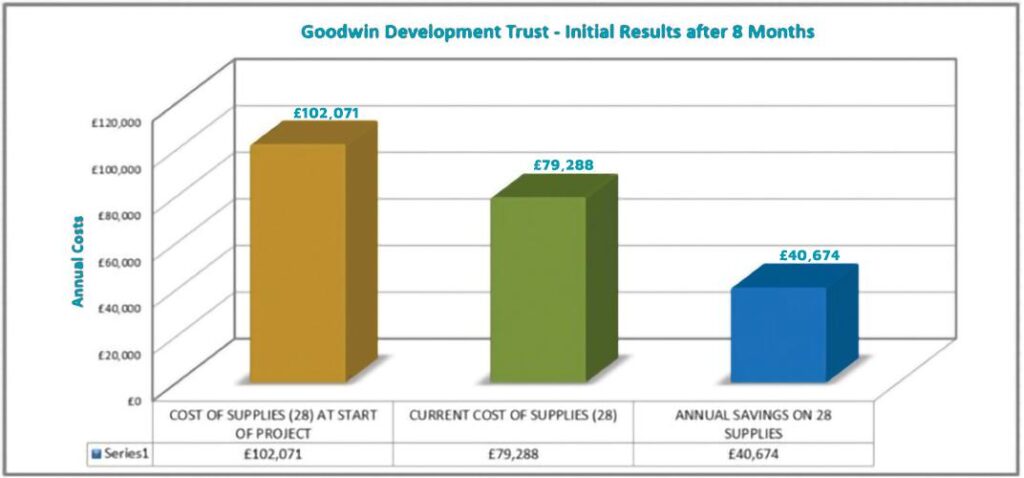
This involved auditing every single supply and gathering all the relevant meter and consumption details whilst confirming and verifying current contract end dates. It was found that a lot of supplies were on ‘out of contract rates’ and the EAG quickly arranged replacement contracts enabling Goodwin to quickly escape from these punitive tariffs. Out of Contract and tariffs can be more than double a supplier’s standard tariff. In Goodwin’s case it meant they were sometimes paying 8 pence per kilowatt hour for gas and 27 pence for electricity. Within a short space of time, we were able to extricate Goodwin from most of these exorbitant rates and replace them with cost effective short-term contracts designed to align with the other Members of the Locality Energy Action Group. This has been a ‘work in progress’, but impressive savings in the region of £40,000 were achieved in the first 8 months of this long-term program.
The project relied on closely monitoring all contracts to ensure termination was submitted in a timely manner and all supplies added to the Group Contract, until there is one single date renewal date for all gas and electricity contracts.
Conclusion: In the first instance, by collecting and verifying all the energy supply data, clarity was created out of a confused and muddled situation. This facilitated the delivery of realistic budget forecasts based on appropriate market rates.
In the longer term, considerable savings were gained by freeing Goodwin from disproportionately costly ‘Out of Contract’ tariffs and putting short-term contracts in place. These supplies were added to the ‘Energy Action Group Basket’ purchase. Then objective has been to add the entire Goodwin Trust portfolio of all gas and electricity supplies to the Buying Basket to achieve leading market rates.